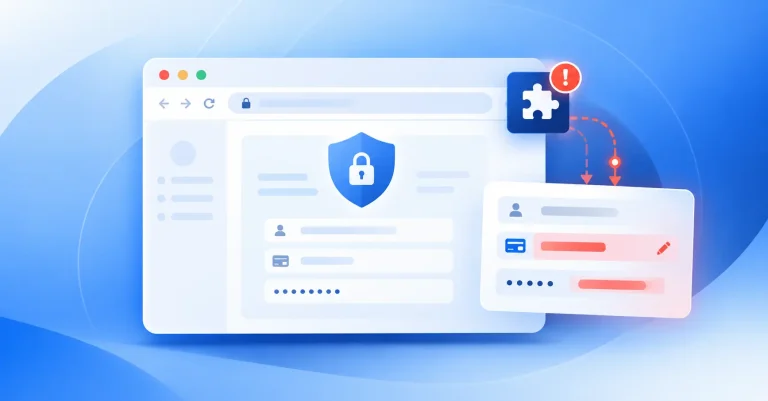
The Identity-to-Browser Attack Path: Why Your Security Stack Has a Blind Spot

- The Timeline Has Compressed Dramatically
- Session Hijacking Bypasses MFA at Scale
- OAuth Token Abuse Is Now the Primary Attack Vector
- Browser Extensions Have Become an Invisible Exfiltration Layer
- Traditional Security Controls Can’t See What’s Happening Inside Browser Sessions
- The Majority of SaaS Usage Bypasses Identity Controls Entirely
- New OAuth Abuse Techniques Are Weaponizing Trusted Authentication Flows
- SaaS Breaches Are Accelerating
- The Identity-to-Browser Gap Creates Exploitable Visibility Blind Spots
- What This Means for Security Teams
- The Path Forward
- References and Further Reading
You’ve probably been managing identity and browser security as separate responsibilities for years.
Not because it made sense. Because that’s how vendors organized their products.
This artificial division created an exploitable gap that attackers now routinely traverse. Identity-based compromise dominated incident response activity in 2025, with identity weaknesses playing a material role in almost 90% of investigations.
The attack path is straightforward: compromised credentials unlock OAuth tokens, which enable browser session hijacking, leading to SaaS data loss.
Security teams excel at monitoring login events. They’ve invested in MFA, SSO, and conditional access policies.
But they often lack visibility into what happens after authentication, where OAuth tokens become weapons inside browser sessions.
The Timeline Has Compressed Dramatically
In the fastest 25% of intrusions, attackers reached data exfiltration in just 72 minutes in 2025, down from 285 minutes in 2024.
That’s a 4X acceleration.
A separate AI-assisted attack simulation reached exfiltration in only 25 minutes. Nearly 48% of incidents included browser-based activity, reflecting how often modern attacks intersect with routine workflows like email, web access, and day-to-day SaaS use.
The browser has become the primary attack surface, turning normal user behavior into an attack vector.
Session Hijacking Bypasses MFA at Scale
Session hijacking has shifted from an edge technique to a primary attack path, driven by the rise of infostealer malware and adversary-in-the-middle phishing. Security reporting consistently shows attackers prioritizing authenticated session artifacts—cookies, tokens, and API keys—over credentials because they bypass login controls entirely.
According to SpyCloud’s 2026 Identity Exposure Report, attackers recaptured 8.6 billion stolen cookies and session artifacts in 2025, highlighting the scale of session-based compromise and its role in bypassing traditional authentication safeguards.
This shift reflects a broader breakdown in authentication-centric defenses. Industry analysis and incident reporting show that once a session is established, security controls often treat activity as trusted, even when the session has been hijacked, allowing attackers to operate without triggering MFA challenges or login alerts.
At the same time, infostealer malware and phishing kits have industrialized session theft, enabling attackers to capture and replay authenticated sessions at scale. Reports note that stolen session cookies are now a common entry point for account takeover and ransomware, reinforcing that MFA protects the login event—not the session that follows.
OAuth tokens function independently of SSO and MFA. Once issued, these bearer tokens work like keys.
Whoever has the token can use it, regardless of whether they completed multi-factor authentication or whether the user’s password has been changed.
OAuth Token Abuse Is Now the Primary Attack Vector
Token theft accounted for 31% of Microsoft 365 breaches in 2025, making it the primary attack vector surpassing traditional credential compromise.
Nearly 40,000 token theft incidents were detected daily across Microsoft environments.
Attackers are combining breach data, phishing captures, malware logs, session tokens, and machine credentials to construct composite identity profiles. These profiles fuel everything from session hijacking and ransomware to supply chain compromise.
Traditional security tools fail against token abuse because stolen tokens are valid tokens that bypass SSO, MFA, and Conditional Access policies.
Detection requires behavioral monitoring focused on IP deviation, User-Agent changes, geographic anomalies, and data access patterns rather than authentication logs.
Browser Extensions Have Become an Invisible Exfiltration Layer
99% of enterprise users have at least one browser extension installed.
Over half grant high or critical permissions. Many are either sideloaded or published by Gmail accounts, with no verification, updates, or accountability.
53% of all installed extensions grant access to sensitive data categories, including cookies, saved passwords, browsing history, and page contents.
A malicious or compromised extension could siphon login tokens, harvest form data, or monitor every page an employee visits.
In 2025, a major phishing campaign compromised the accounts of Chrome extension developers, allowing attackers to inject malware into over 35 extensions, some of which were used by enterprises globally.
Over 8 million installs of eight extensions were harvesting users’ complete and extended AI conversations and selling them for marketing purposes. Seven of these extensions were endorsed by companies that claimed they met their quality standards.
Traditional Security Controls Can’t See What’s Happening Inside Browser Sessions
EDR sees processes. SSE sees network traffic. DLP scans files.
None of them inspect what’s happening inside the session, like which SaaS tab is open, what data is being pasted, or which extension is injecting scripts.
Browser-based session management has quietly become a critical vulnerability. Session tokens exist in memory or local storage and can be intercepted during transit or stolen from browsers.
Unlike passwords, which are encrypted and stored, session tokens are ephemeral and often unprotected.
The Majority of SaaS Usage Bypasses Identity Controls Entirely
Over two-thirds of logins happen outside of SSO.
Nearly half use personal credentials, making it impossible for security teams to know who is accessing what, or from where.
With 83% of SaaS applications managed outside IT control and organizations adding four new tools monthly, businesses face a growing maze of unmonitored “shadow identities.”
99% of cloud users, roles, and services had excessive permissions, including access that had gone unused for 60 days or longer.
Over-permissioned identities create predictable escalation paths once an attacker gains a foothold.
New OAuth Abuse Techniques Are Weaponizing Trusted Authentication Flows
ConsentFix represents a sophisticated evolution in token theft.
It targets Microsoft Entra ID through social engineering that tricks users into providing OAuth authorization codes via drag-and-drop or copy-paste actions, requiring no password theft and triggering no MFA prompts.
Attackers increasingly avoid the well-defended front door and instead abuse the gaps around OAuth, service principals, and tokens.
In documented scenarios, attackers start with a compromised low-privileged user, discover that this user “owns” an enterprise application with a privileged role, and then add a new client secret to that service principal.
OAuth redirection is being repurposed as a phishing delivery path. Trusted authentication flows are weaponized to move users from legitimate sign-in pages to attacker-controlled infrastructure.
SaaS Breaches Are Accelerating
Monthly SaaS breaches have increased by 300% year-over-year.
Attacks can compromise sensitive data in as little as 9 minutes. 84% of compromised accounts had MFA enabled, proving additional security measures are necessary.
SaaS application data played a role in 23% of cases in 2025, up from 18% in 2024 and 6% in 2022.
OAuth apps and API integrations often hold broad permissions that remain active even after employees leave or workflows change.
On average, a single organization uses 130 different Software-as-a-Service applications. 45% of organizations reported experiencing a cybersecurity incident through a SaaS application in the last year.
The Identity-to-Browser Gap Creates Exploitable Visibility Blind Spots
Attacks on browsers, whatever their intent, often involve identity theft.
Theft of credentials, session cookies, and OAuth tokens creates opportunities for ransomware attacks upon SaaS apps and cloud storage.
“This all happens in the browser,” researchers noted. “The endpoint is not touched. EDR software notices nothing.”
85% of SaaS compromises target identities. Organizations excel at monitoring login events but often lack visibility into what happens after authentication, where OAuth tokens become weapons inside browser sessions.
Modern browsers and SaaS applications sync credentials across devices, expanding the attack surface in ways that traditional security measures were never built to handle.
What This Means for Security Teams
The real control plane is the end-to-end identity-to-browser session, not the individual tools you’ve bought.
Teams still think in product lanes: identity, CASB, DLP, EDR, browser. They assume “we’ve invested in all the boxes, therefore the path is covered,” even though attacks now move fluidly through OAuth apps, extensions, GenAI tools, and browser sessions that sit between those boxes.
When something serious happens, they discover they have logs and alerts everywhere but no single system that can see, score, and act on that full identity-to-browser attack path in real time.
Treat integration attacks, extensions, and AI tools as first-class identity surfaces. Design your program so detection, DLP, and response are unified across SaaS and the browser.
Manual rules and siloed tools will always fall behind how people actually work.
If you start from that principle, you’re more likely to invest in context-aware, automated guardrails rather than relying on manual SaaS DLP or point products.
That’s what makes the difference between “we saw the incident in logs two weeks later” and “we contained it in minutes and have the evidence to satisfy auditors and customers.”
The Path Forward
Browser security is identity security now.
The artificial division between these domains created the gap attackers exploit. Closing it requires unified visibility and control across the full session lifecycle.
Start by mapping where your identity controls end and where browser activity begins. Identify the tools, workflows, and data flows that exist in that gap.
Then build or adopt systems that treat the browser as an identity infrastructure layer, not just a network endpoint.
The organizations that recognize this shift early will compress their response times, reduce their attack surface, and build the resilience that matters when incidents occur.
The ones that wait will keep discovering breaches in their logs weeks after the damage is done.
References and Further Reading
- Identity-Based Attacks and Compromise:
Help Net Security – Identity-based cyberattacks compromise - Browser Extension Security:
The Hacker News – New browser security report reveals extension risks - OAuth Device Code Phishing and Token Theft:
Proofpoint – Microsoft OAuth App Impersonation Campaign Leads to MFA Phishing
The Hacker News – Device Code Phishing Hits 340+ Microsoft 365 Organizations
Cloud Security Alliance – OAuth Device Code Phishing Hits 340+ Microsoft 365 Organizations - Session Hijacking Growth and Statistics:
SpyCloud – Cyberattacks in a passwordless world – the emergence of session hijacking
SpyCloud – Cybersecurity Industry Statistics: ATO, Ransomware, Breaches & Fraud
Flare – The Account and Session Takeover Economy - SpyCloud 2026 Identity Exposure Report:
Analytics Insight – SpyCloud’s 2026 Identity Exposure Report Reveals Explosion of Non-Human Identity Theft
The Tech Edvocate – Surge in Identity Data Exposures: SpyCloud’s 2026 Report Highlights Shift Towards API Key Theft and Session Hijacking - Browser Extension Risks and Enterprise Security:
The Hacker News – Majority of Browser Extensions Can Access Sensitive Enterprise Data
Barracuda Networks – The hidden cybersecurity risk lurking in your browser extensions
The Hacker News – Malicious Chrome Extensions Caught Stealing Business Data, Emails, and Browsing History - State of Browser Security 2025/2026:
BleepingComputer – 2026 Browser Data Reveals Major Enterprise Security Blind Spots
Keep Aware – The State of Browser Security Report 2025
Palo Alto Networks – AI and the New Browser Security Landscape - Breach Statistics and Trends 2026:
DataFeature – Cybersecurity Breach Statistics 2026: Breach Rates, Sectors Targeted & Top Causes