Spin.AI Browser Extension Risk Assessment Insights Now Available in Microsoft Edge for Business

Browser extensions are part of how employees get work done every day. They are also one of the fastest-growing sources of supply chain risk inside the enterprise, and one of the hardest for IT and security teams to evaluate at scale.
Browser extension risk assessment insights from Spin.AI are now available in Microsoft Edge for Business, surfaced within the Edge management service, so organizations can use them to help evaluate browser extension risk alongside the other insights and admin controls Edge for Business already provides.
At a glance
- What: Spin.AI browser extension risk assessment insights
- Where: Surfaced within the Edge management service in Microsoft Edge for Business
- Why: Helps IT and security teams evaluate extension risk with 25+ risk factors per extension
Why are browser extensions a growing security risk?
In a cloud-first world, the browser is the primary gateway to work, which contains sensitive corporate data. Email content, company documents, CRM records, financial analyses, product roadmaps, and AI tools all live behind a browser tab. That makes every extension running in the browser a direct path to the sensitive information employees work with every single day.
Spin.AI’s research team has tracked this shift for years. Here is what the data shows.
Extension sprawl is the norm, and much of it is high risk
Spin.AI has assessed more than 1,000,000 browser extensions and applications. According to Spin.AI’s AI Compliance and Browser Extension Risks in 2026 research:
- 50% of extensions in use are classified as high risk, many with elevated AI-powered data exfiltration capabilities.
- 43,000 extensions have unknown or anonymous authors, creating supply chain and compliance risk that is difficult to trace.
- Organizations with 2,000+ employees use an average of 1,454 browser extensions, raising the risk of unmonitored shadow IT.
At that volume, manual review stops being realistic. Spin.AI’s original Browser Extension Risk Report found that a manual risk assessment can take two weeks per extension, which no security team can sustain across more than a thousand extensions.
Trusted extensions can turn malicious overnight
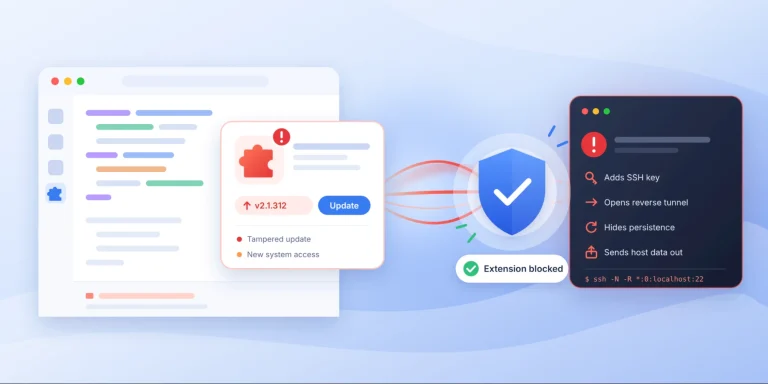
An extension that is safe on the day it is approved can become a threat with its next update. Attackers target extensions that already have users, trust, and broad permissions, then deliver malicious code through the same update channel organizations rely on.
Trust signals don’t stop it.
In last year’s RedDirection browser extension attack campaign, first disclosed in July 2025, attackers hid surveillance and browser hijacking inside everyday tools such as emoji keyboards, weather forecasts, video downloaders, VPN proxies, and dark themes.
The extensions worked as advertised while quietly intercepting web traffic and redirecting users to attacker-controlled sites, opening the door to credential theft through fake banking pages and malware delivered through fake updates.
What made them so effective was how trustworthy they looked. Many carried verified badges, positive reviews, featured placement, and high install counts, and none of them were malicious at release. Malicious code arrived later through routine version updates, sometimes years after launch, and installed automatically on users’ browsers.
As the investigation widened, 18 additional malicious extensions affecting 14.2 million users surfaced, bringing the campaign to 36 extensions and more than 16 million users.
One compromised developer can put millions of users at risk.
RedDirection wasn’t the first campaign to exploit the update channel. Months earlier, in December 2024, the Cyberhaven extension attack showed how little it takes. Attackers phished an extension developer and used that access to push malicious code to the extension’s users, with data exfiltration centered on Facebook business accounts. The incident turned out to be part of a wider campaign targeting extension developers. Eight previously unreported compromised extensions brought the total to 40 extensions and roughly 3.7 million affected users.
Exposure lasts months, not days.
In both campaigns, the damage didn’t end at discovery. The malicious RedDirection extensions took nearly 98 days on average to be patched or removed, and some extensions in the Cyberhaven campaign stayed compromised for more than 300 days before receiving a patch.
In each case, the full scope only became clear after continuous threat intelligence uncovered compromised extensions that initial reports had missed.
Approving an extension once is not enough
Extension risk needs to be evaluated continuously, as extensions change owners, permissions, and code.
AI is raising the stakes
AI-powered extensions are multiplying, and so are AI-driven threats. Spin.AI’s AI Compliance and Browser Extension Risks in 2026 report found high-risk ratings across every AI risk category it examined, including:
- AI-enhanced phishing: 70% high risk
- Compliance violations (GDPR/CCPA): 67% high risk
- Autonomous data harvesting: 62% high risk
- AI supply chain risks: 60% high risk
The report also notes that extensions running offline language models inside the browser can operate without generating the network traffic many perimeter and DLP tools rely on. Extensions that collect behavioral analytics, screen captures, or keystroke patterns can create compliance exposure under regulations such as GDPR, CCPA, and HIPAA.
For security leaders, this is now a security posture question as much as an IT hygiene one. Spin.AI tracks newly hacked and compromised extensions in its Free Dangerous Browser Extensions Tracker.
How do Spin.AI insights help IT and security teams in Microsoft Edge for Business?
Security teams need context at the moment of decision: what an extension does, what it can access, and how risky it is. Spin.AI contributes browser extension risk assessments in Edge for Business, giving IT and security teams additional context to make informed decisions about which extensions to allow or block in their organization.
What goes into a Spin.AI risk assessment
The insights in Edge for Business are backed by the same detection engine and risk database Spin.AI applies across our own browser ecosystem.
- Risk intelligence at scale: the Spin.AI engine has evaluated more than 1,000,000 browser extensions and applications.
- 25+ risk factors per extension: each extension is scored across more than 25 individual risk factors spanning business, compliance, and security considerations.
- Vulnerability assessment: every extension is assessed for exploitable security vulnerabilities.
- Code analysis: extensions are analyzed against Spin.AI’s library of suspicious and malicious signatures.
- Behavioral sandboxing: extensions are sandboxed for anomalous behavior to help detect emerging attack trends.
This analysis underpins the extension risk assessment insights surfaced in the Edge management service.
Explore extension risks and vulnerabilities with Spin.AI’s Free Browser Extension Risk Assessment tool.
Learn more about the integration and explore Edge for Business
Frequently asked questions
Why is browser extension security an urgent priority?
Because extensions run inside the browser, now the primary gateway to work, with access to the pages and information employees use. Spin.AI research classifies 50% of extensions in use as high risk, and campaigns such as RedDirection show that trusted extensions can be turned malicious through routine updates.
What is the Spin.AI integration with Microsoft Edge for Business?
Spin.AI contributes extension risk assessments in Microsoft Edge for Business. Edge for Business surfaces these insights within the Edge management service, where organizations can use them to help evaluate browser extension risk.
Where do Edge for Business admins see Spin.AI insights?
Spin.AI extension risk assessment insights are surfaced within the Edge management service on the extensions monitoring page. Admins can view the risk score provided by Spin.AI for each individual extension.
What does a Spin.AI risk assessment evaluate?
Each extension is scored across more than 25 risk factors spanning business, compliance, and security considerations. Extensions are assessed for exploitable vulnerabilities, analyzed for risky code, and sandboxed for anomalous behavior.